
Handling a cancellation without losing the client
The terms are on paper, but you still have to have the conversation. How to invoice what you're owed and keep the relationship.
The email arrives on a Tuesday morning. The event in two weeks isn't happening — restructuring, the speaker is ill, the budget is frozen. The client is very sorry.
You have a signed quote with a cancellation scale saying you may charge fifty percent. And now you have to have a conversation almost nobody is good at.
Respond first, invoice later
The temptation is to reach for the terms immediately. Don't, not in the first contact. Call, say you're sorry to hear it, and ask what happened.
That isn't just courtesy, it's information. An event being postponed is a very different thing from one being cancelled outright, and a client in trouble themselves needs a different approach from one who simply changed their mind.
Offer to move it before you cancel it
In a large share of cancellations the event isn't gone, only the date. If you have an alternative within a few months, that's better for both parties than a cancellation invoice.
A workable arrangement: moving to a date within six months costs nothing, provided it falls in the same season and room category. Outside that, the normal terms apply. Generous enough to keep the conversation open, tight enough to stop your date sliding indefinitely.
Invoice what was actually incurred
If cancelling is the outcome, split your invoice into what you spent and what you're losing. For the recipient, that difference is the difference between a bill and a penalty.
| Line | How it reads on the invoice |
|---|---|
| Goods already purchased | Concrete costs, usually not cancellable |
| Staff hours rostered | Depends how late the cancellation came |
| Reserved room capacity | The part you won't now sell |
An invoice with those three lines is rarely disputed. A single line reading "cancellation charge 50%" almost always is — not because the amount is unreasonable, but because it explains nothing.
Pass it on internally
A cancellation isn't only an invoice. The room has to be released, staff stood down, purchasing adjusted and suppliers told.
At most venues that happens piecemeal, and something always survives: an order that arrives anyway, a casual worker turning up for nothing, a room still blocked for another week.
So make one checklist you run through on every cancellation. Five lines, always the same. It saves you the costs you'd otherwise incur for an event that isn't happening — and those are exactly the costs you can't pass on.
When to deviate from your own scale
Sometimes charging less than you may is the smart move. With a regular client of many years, with a cancellation nobody could have foreseen, or if you resell the date after all.
Do it explicitly and as a one-off: "under the terms this is fifty percent; we're charging twenty-five because we've been able to partly fill the date." That preserves the agreement for next time and gives away something the other party can actually see.
What you shouldn't do is quietly waive it. Then your client learns the scale isn't real — and the next cancellation becomes a discussion instead of an invoice.
Read on
More articles
 Invoicing
VAT on events: when 9% applies and when 21% does
Room hire, catering, admission and parking don't share a VAT rate. A practical overview for anyone drawing up quotes and invoices.
 Invoicing
Why your invoices get paid late
The average event invoice stays open for 38 days on a 14-day term. These are the causes, and none of them is that the client doesn't want to pay.
 Invoicing
Do you know what your package really costs?
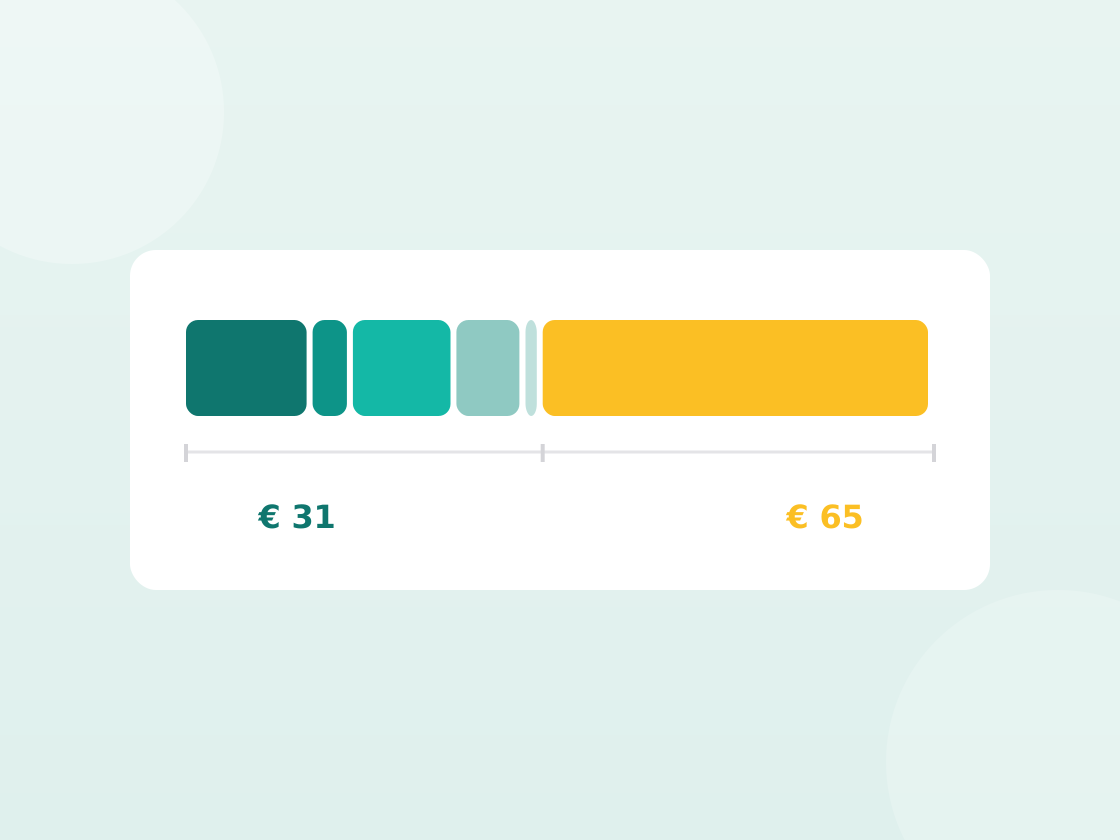
Many packages were priced years ago and only indexed since. How to build a cost price that holds up.
From request to invoice in one platform
Try MiceBird free for fourteen days. Your offering in it, your branding around it — no implementation project.