
How do you price a ticket?
Cost plus margin doesn't work for events. Four ways to arrive at a price, and why the cheapest is rarely the best.
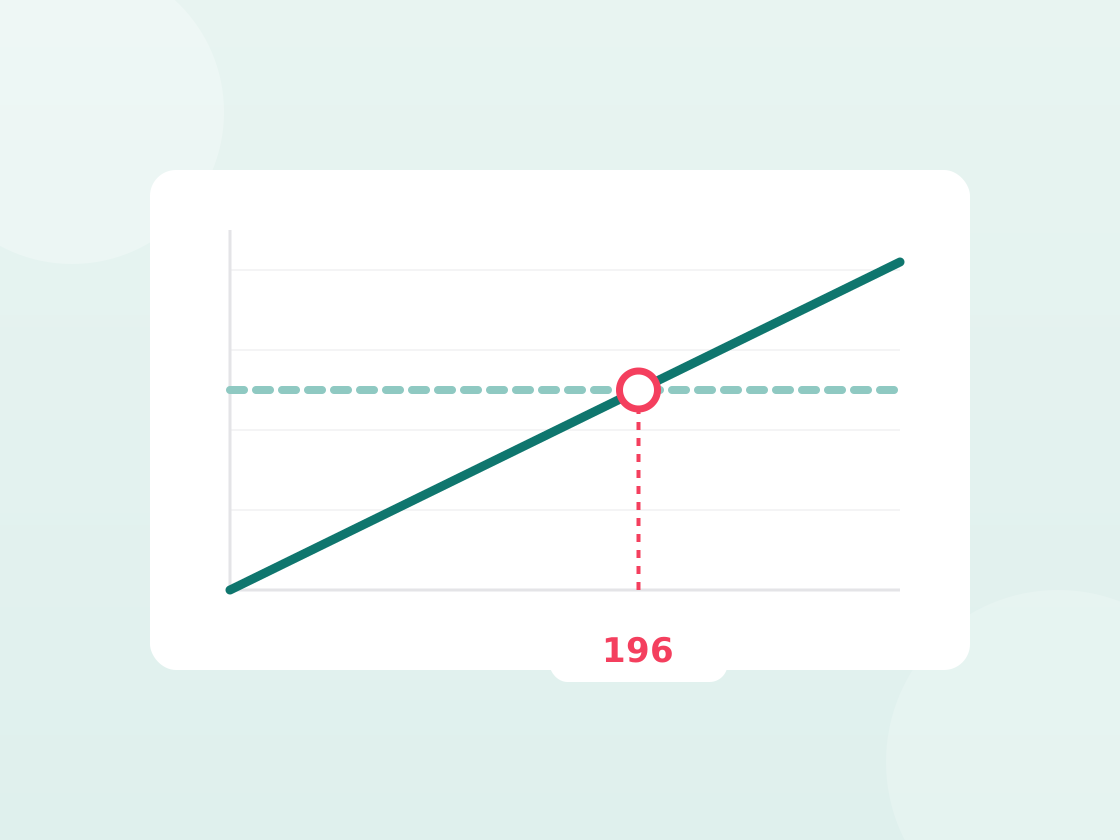
Pricing a product is relatively simple: cost, margin, done. For an event it doesn't work, because your largest cost — the room, the technical setup, the speaker — doesn't change with attendance. Whether fifty or a hundred and fifty people come, the band costs the same.
That makes the ticket price a choice rather than a calculation.
Start at break-even
Before thinking about what a ticket is worth, you need to know how many visitors get you to zero. That takes two figures: your fixed costs and your variable cost per visitor.
Say room, technical and promotion together come to € 4,500. Per visitor you spend € 12 on catering and materials. At a ticket price of € 35 you keep € 23 per visitor, so break-even is 196 visitors.
That number is your most important lever. It tells you whether you need a smaller room, whether the price has to go up, or whether you're planning to sell more than is realistic.
Four ways to set a price
Cost-driven. Break-even at a realistic attendance, plus a margin. Safe, but ignores what people will actually pay.
Market-driven. Look at what comparable events charge. Useful as a reference, dangerous as a rule — you don't know whether their price works.
Value-driven. What does the visitor get out of it? At a business event with a strong speaker that's far more than at a drinks reception, and the price may reflect it.
Differentiated. Different prices for different groups: early bird, student, group, or a premium ticket with extras. This extracts the most from the same room.
Too cheap is a real risk
The reflex with a new event is to start low: volume first, raise later. That's riskier than it sounds.
A low price signals what it's worth. A conference day at twenty-five euros prompts doubt rather than enthusiasm from a business audience. And going up is hard: your audience knows the old price, and every increase is an announcement.
The arithmetic often works against you too. From € 35 to € 25 removes nearly thirty percent of your margin — so you have to sell considerably more tickets for the same result, in the same room, on the same promotional budget.
Booking fees are part of the price
If you charge a booking fee, factor it into how you think about the price. A € 35 ticket that turns out to be € 39.50 at checkout is judged by the buyer as € 39.50 — not as € 35 with a justifiable addition.
Either name the total from the start, or make the fee small enough not to register. The middle path — a modest ticket price with a hefty surcharge on the final screen — is the variant that produces the most abandoned baskets.
Read on
More articles
 Ticket sales
Seven reasons visitors don't finish buying their ticket
On average more than half of visitors drop out between picking a ticket and paying. These are the points where they leave, and what to do about it.
 Ticket sales
Early-bird pricing only works with a real deadline
Ticket rounds don't sell because they're cheaper, they sell because they end. How to structure them without giving away revenue.
 Ticket sales
What to do when you're sold out
Sold out isn't an end point but a starting point. How to use a waiting list, and why you should have one regardless.
From request to invoice in one platform
Try MiceBird free for fourteen days. Your offering in it, your branding around it — no implementation project.